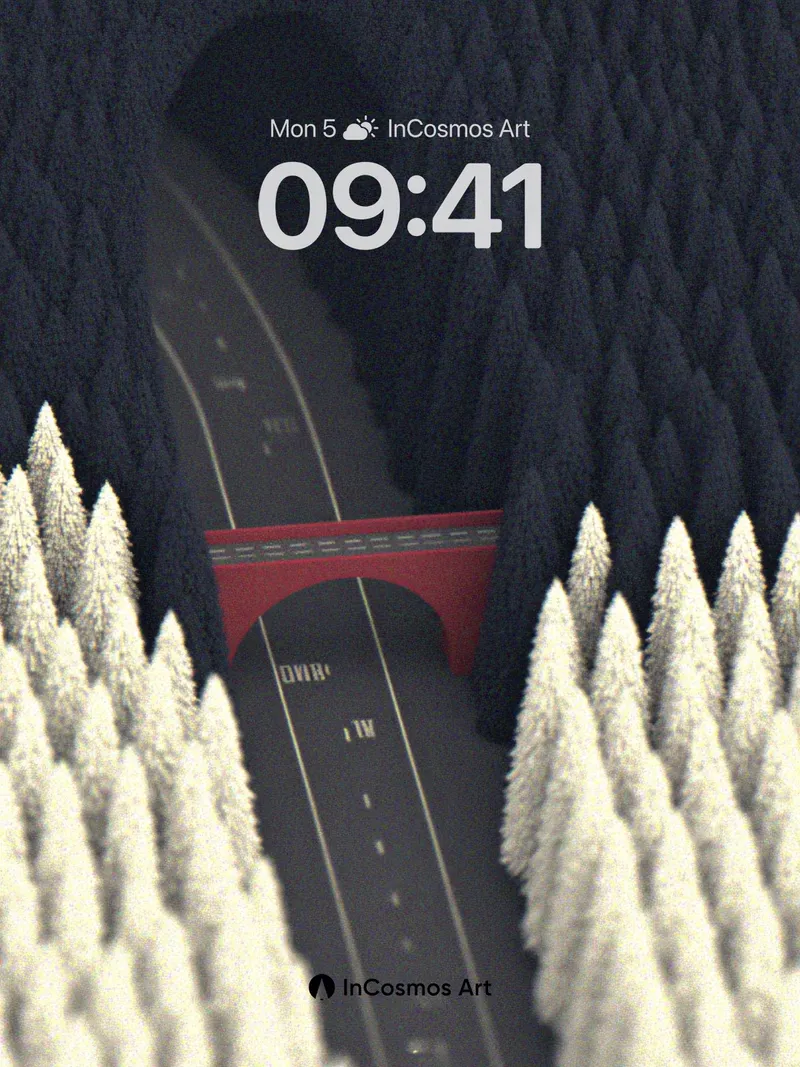
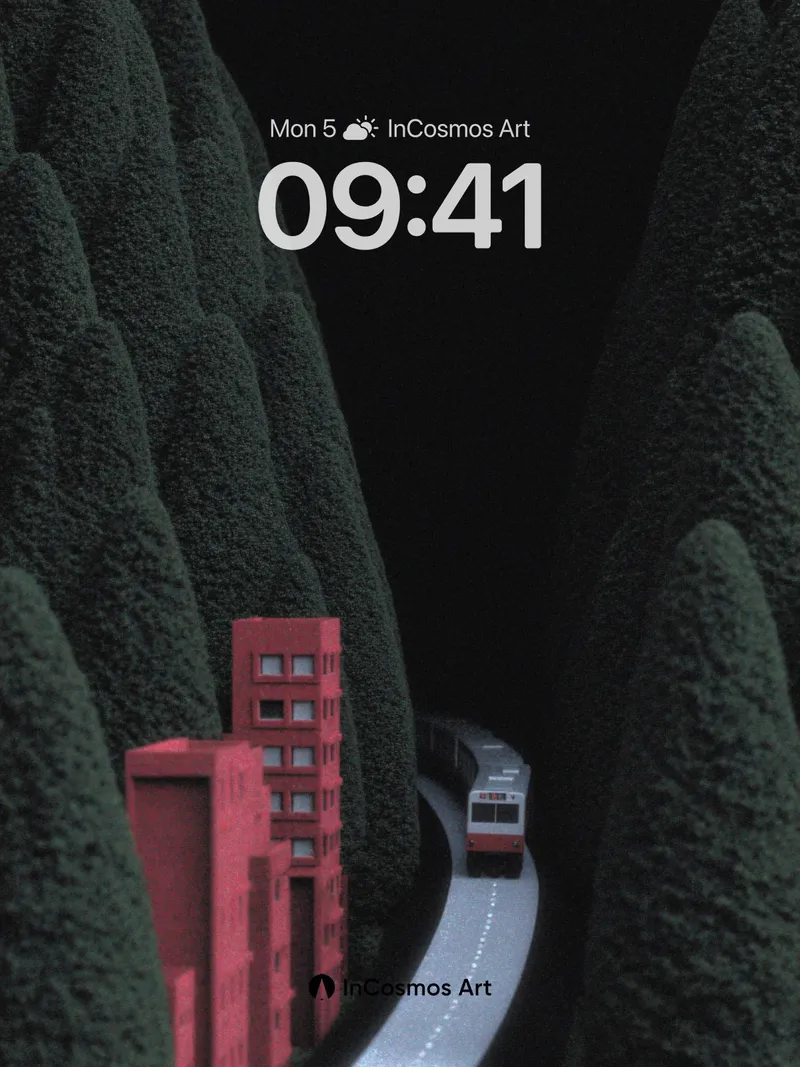
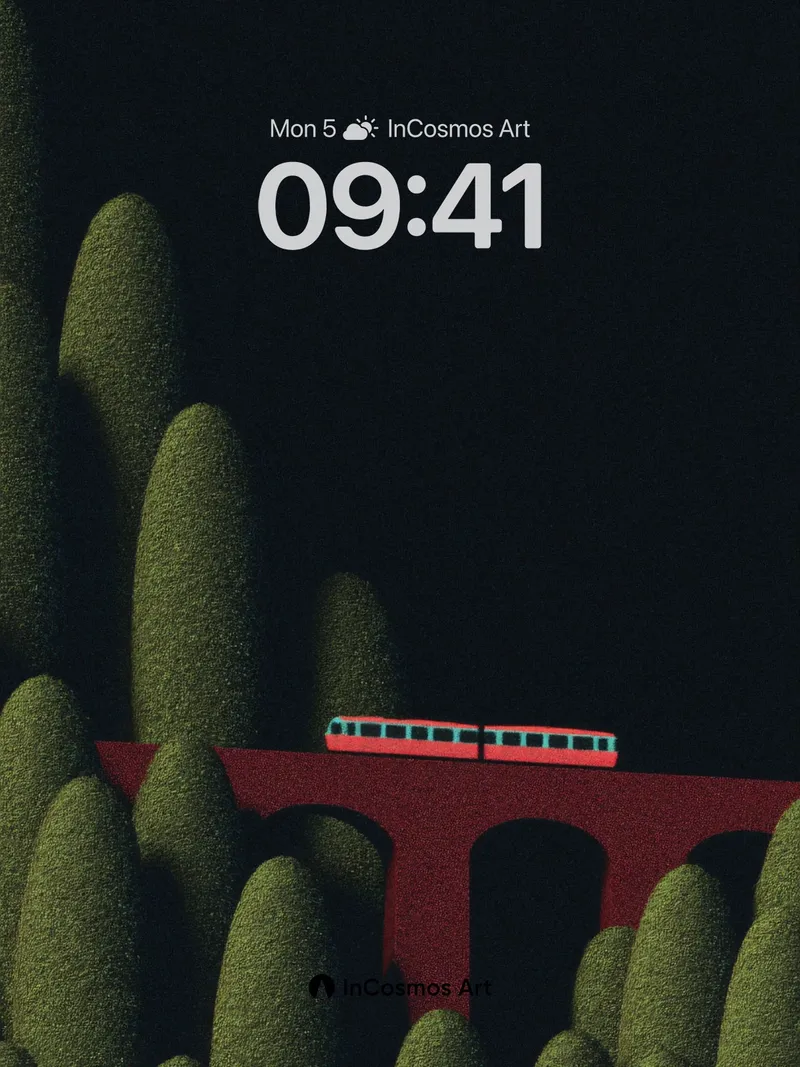
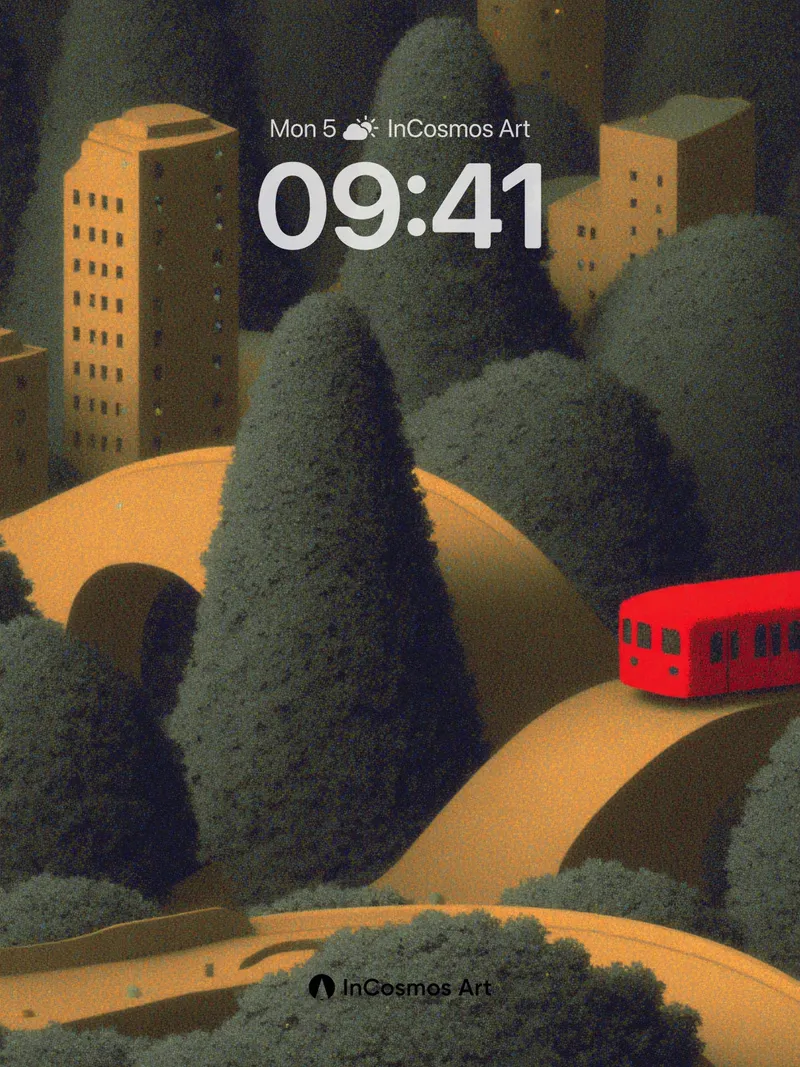
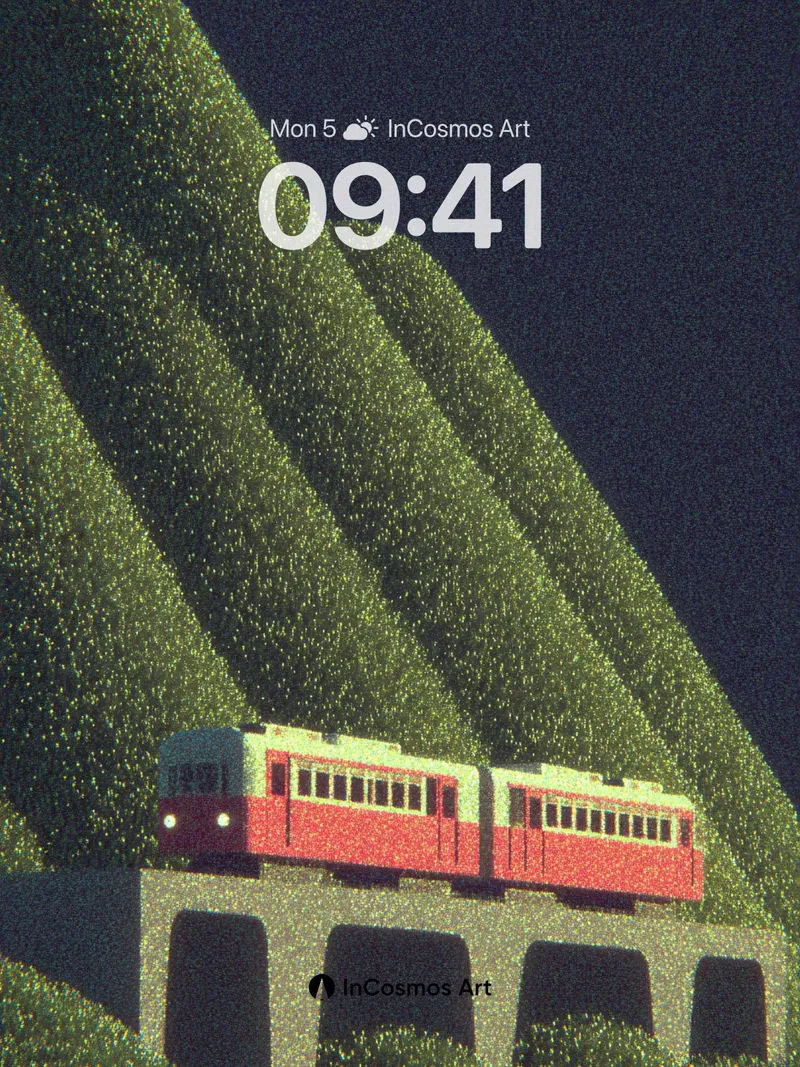
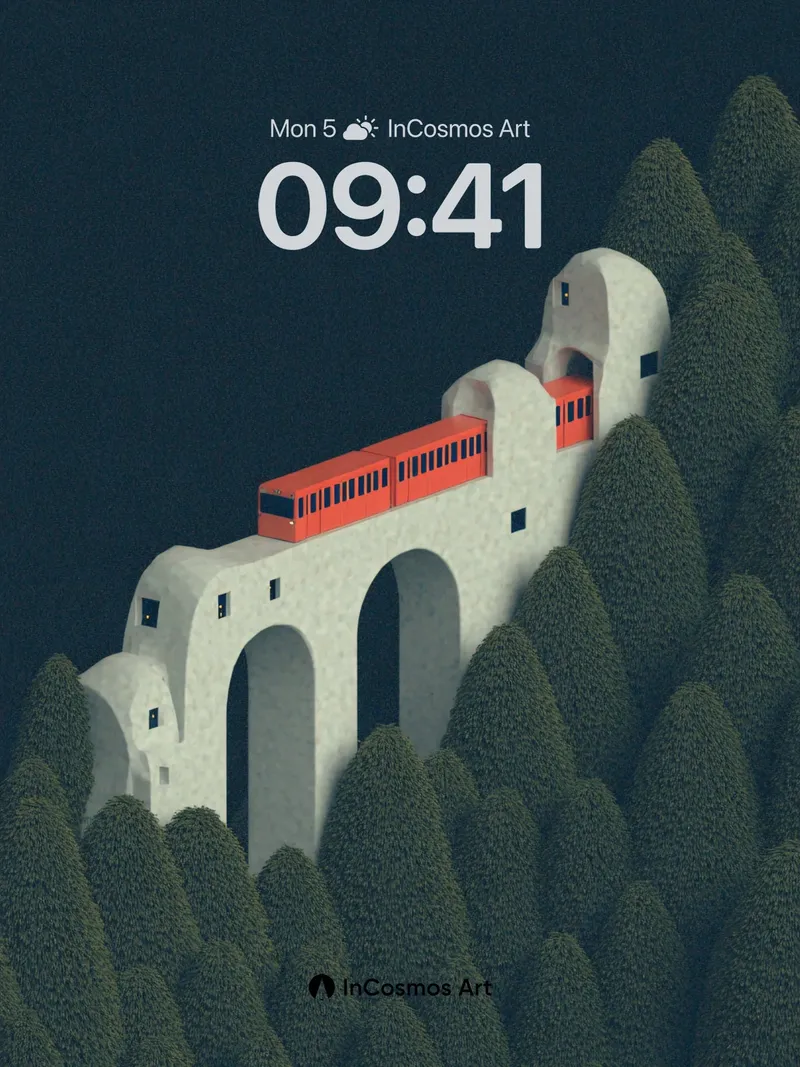
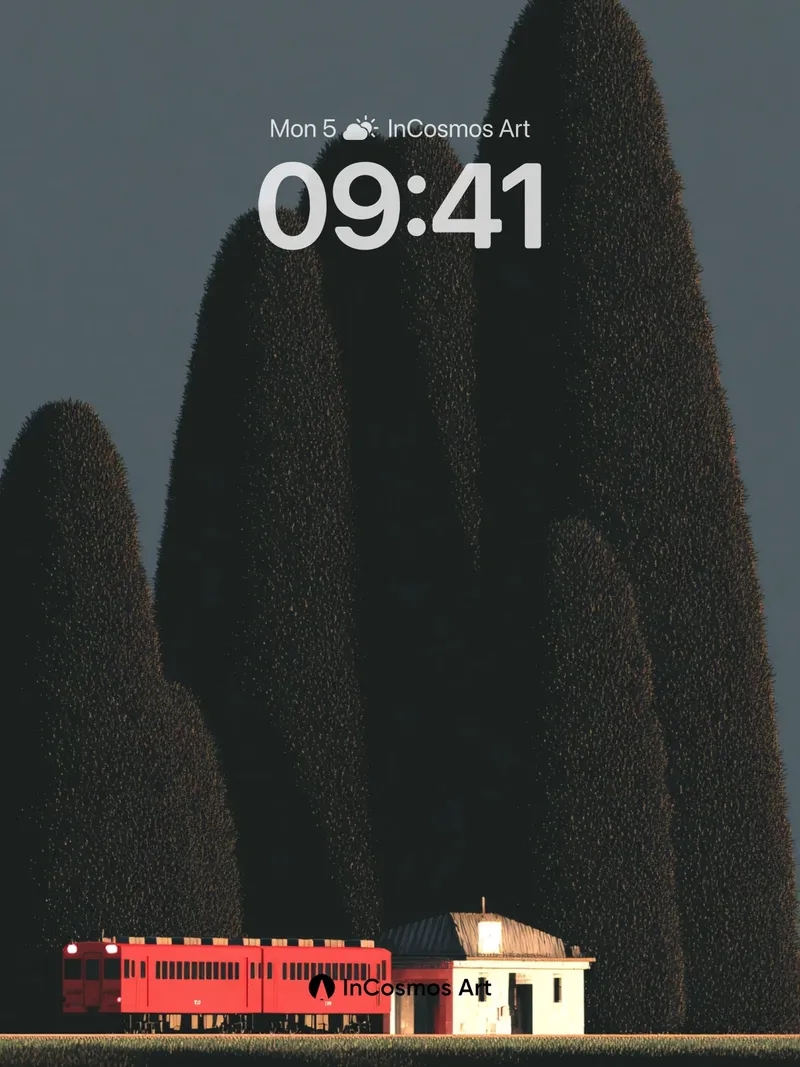
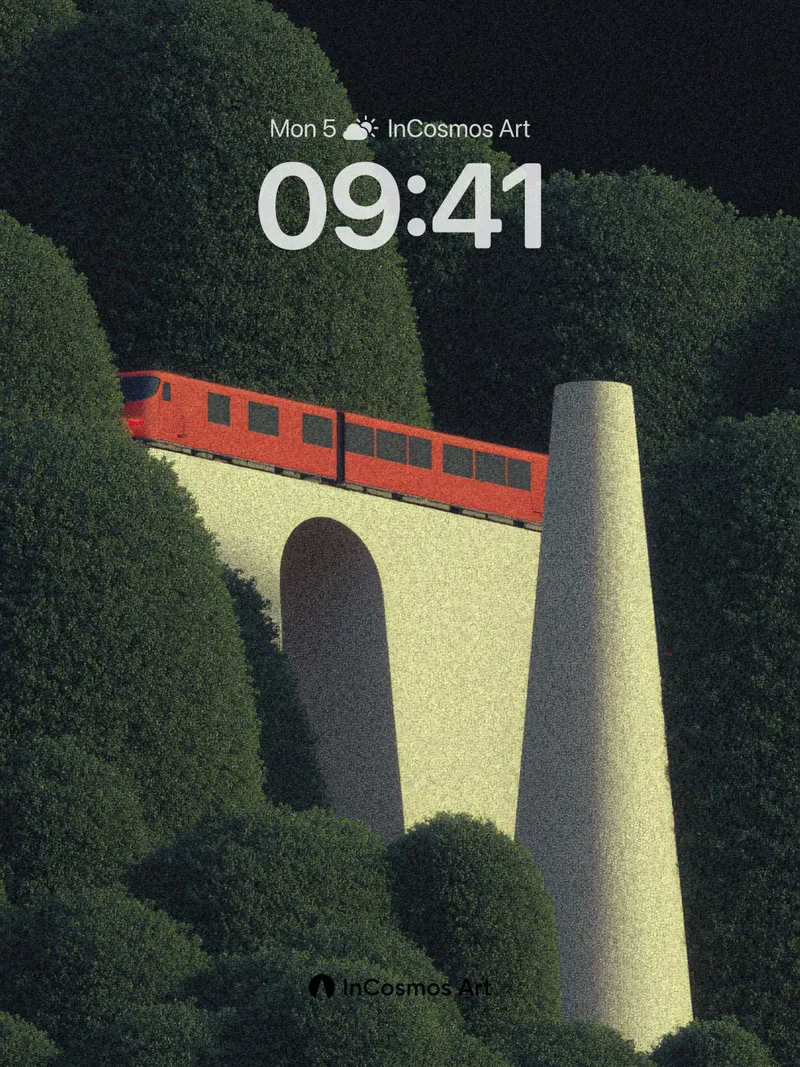
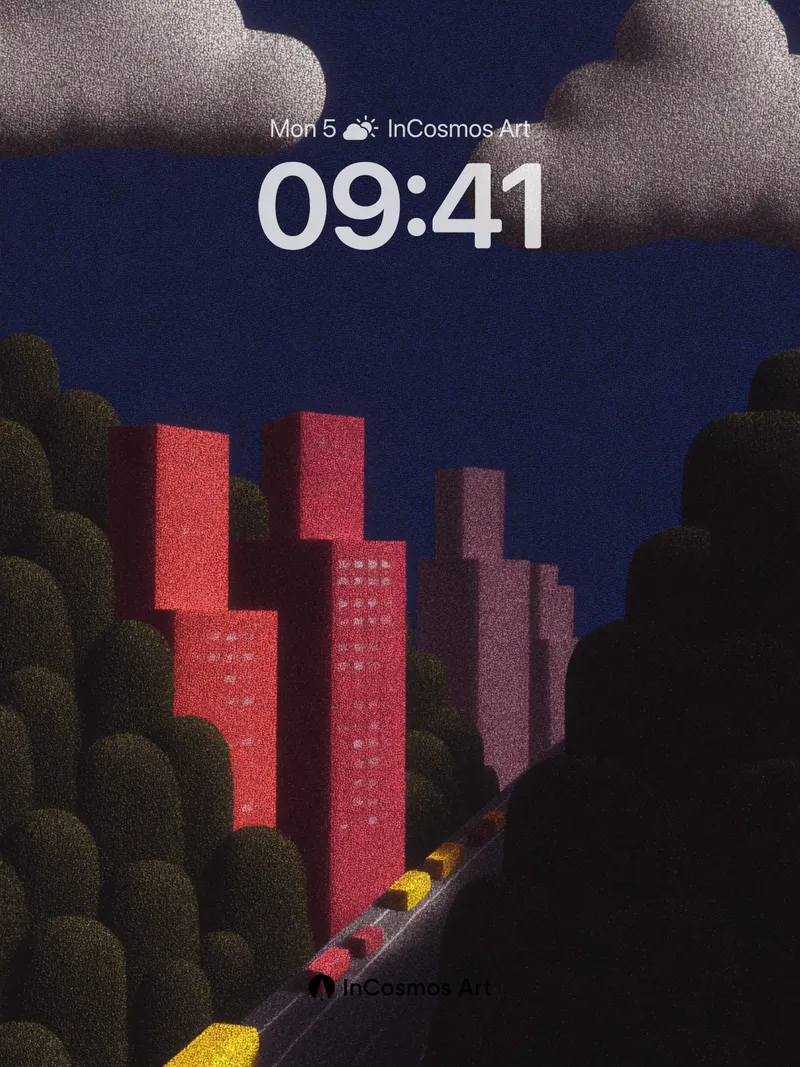
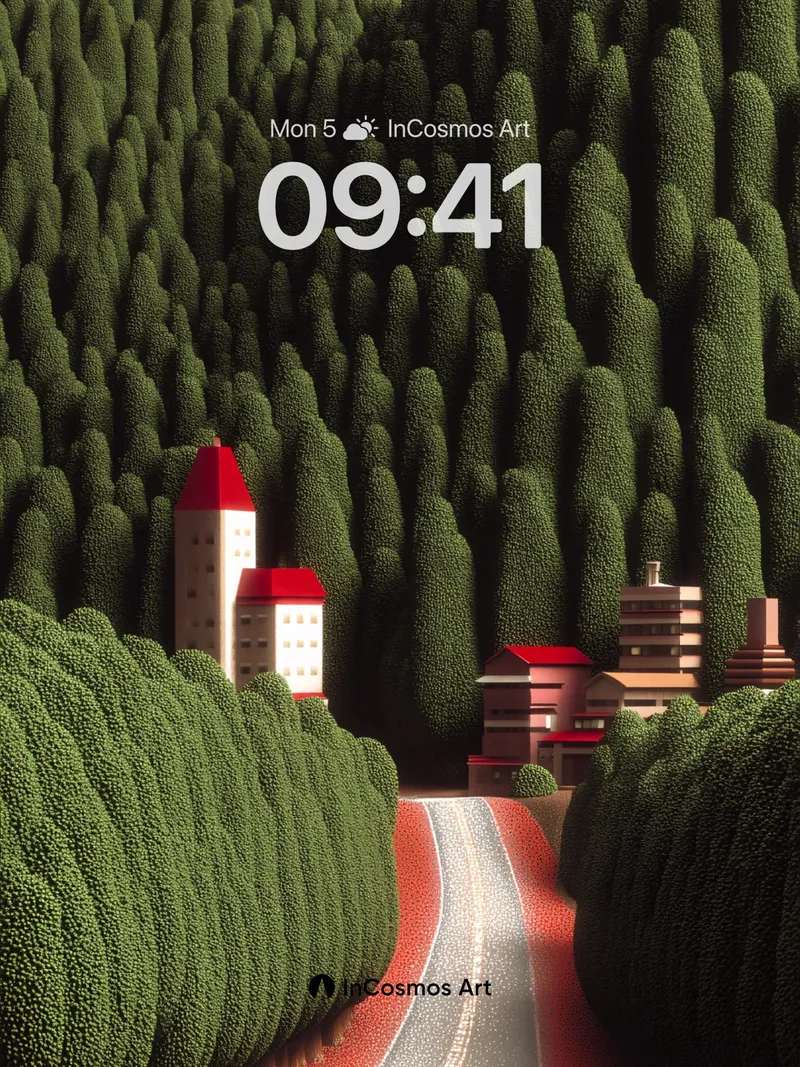
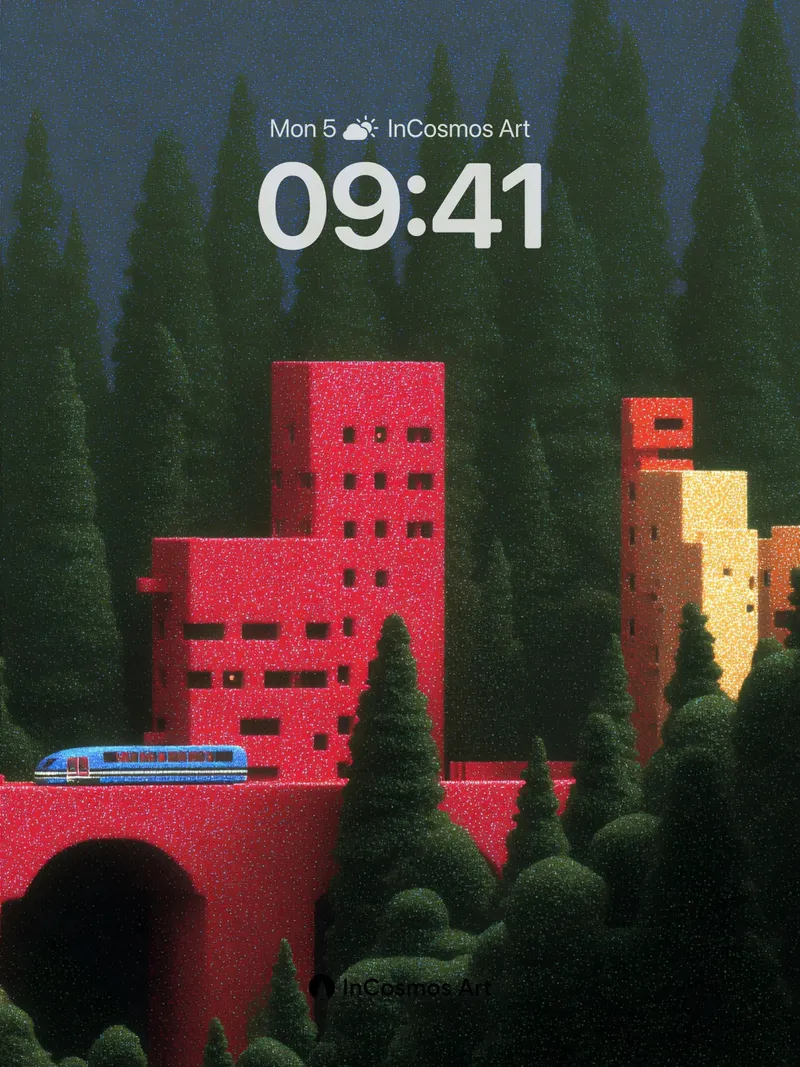
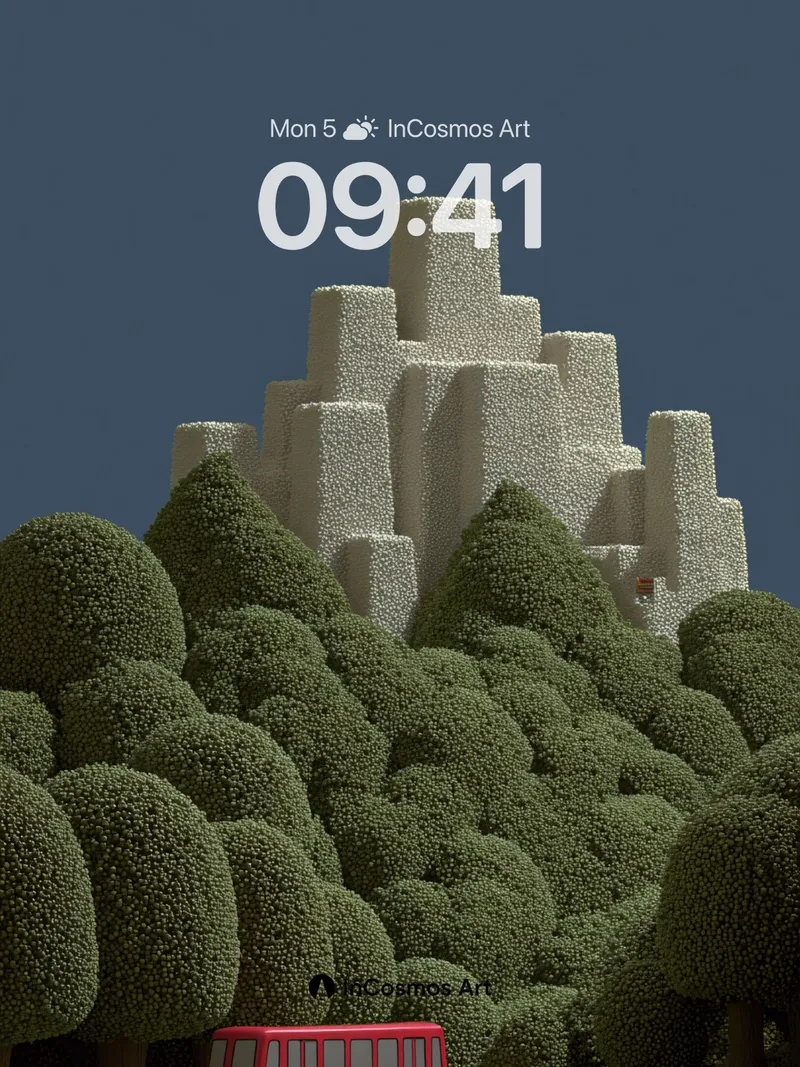
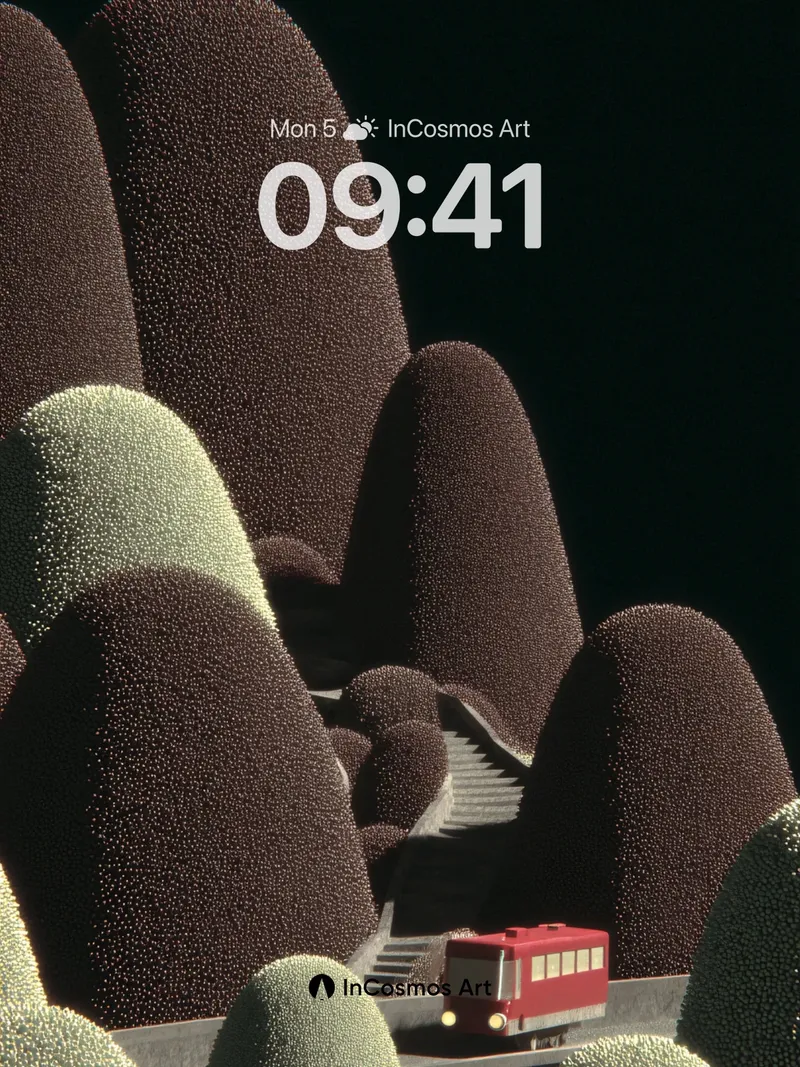
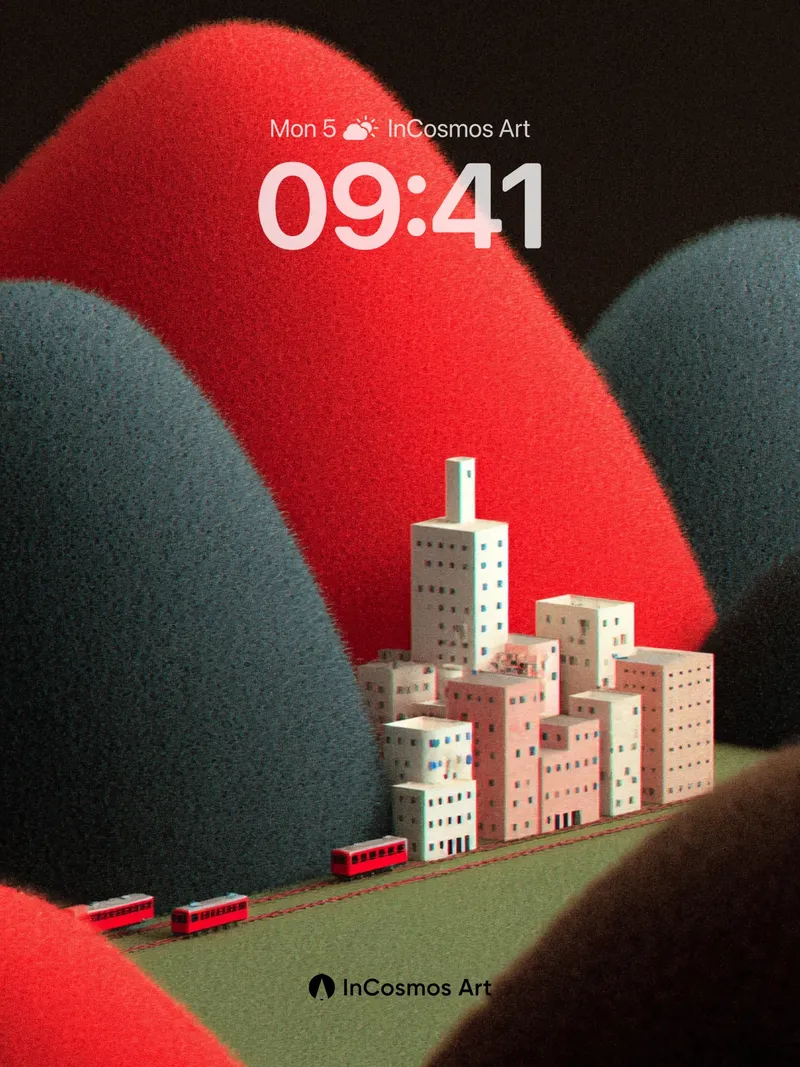
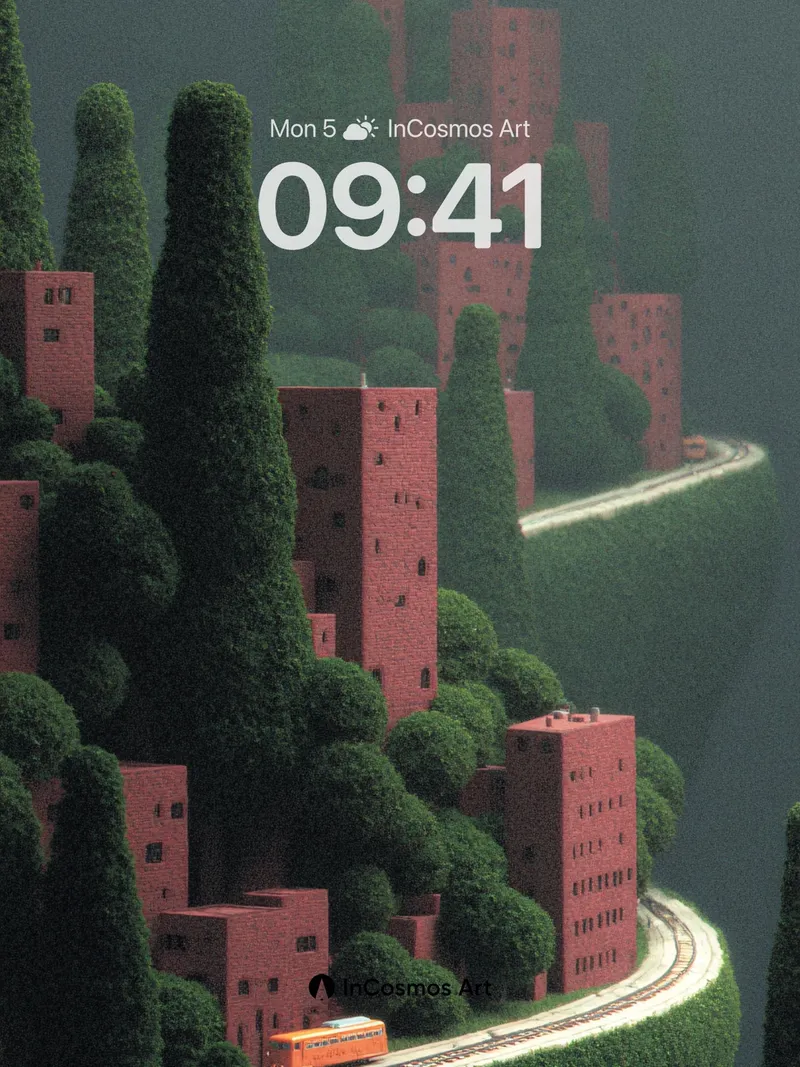
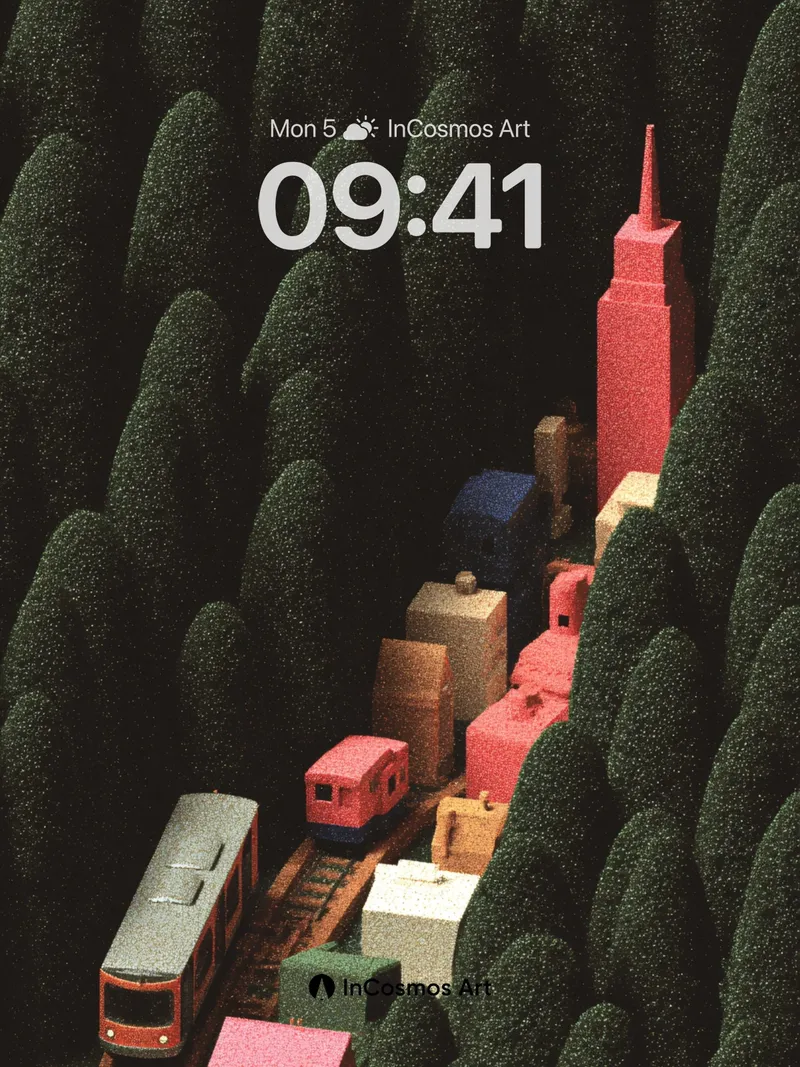
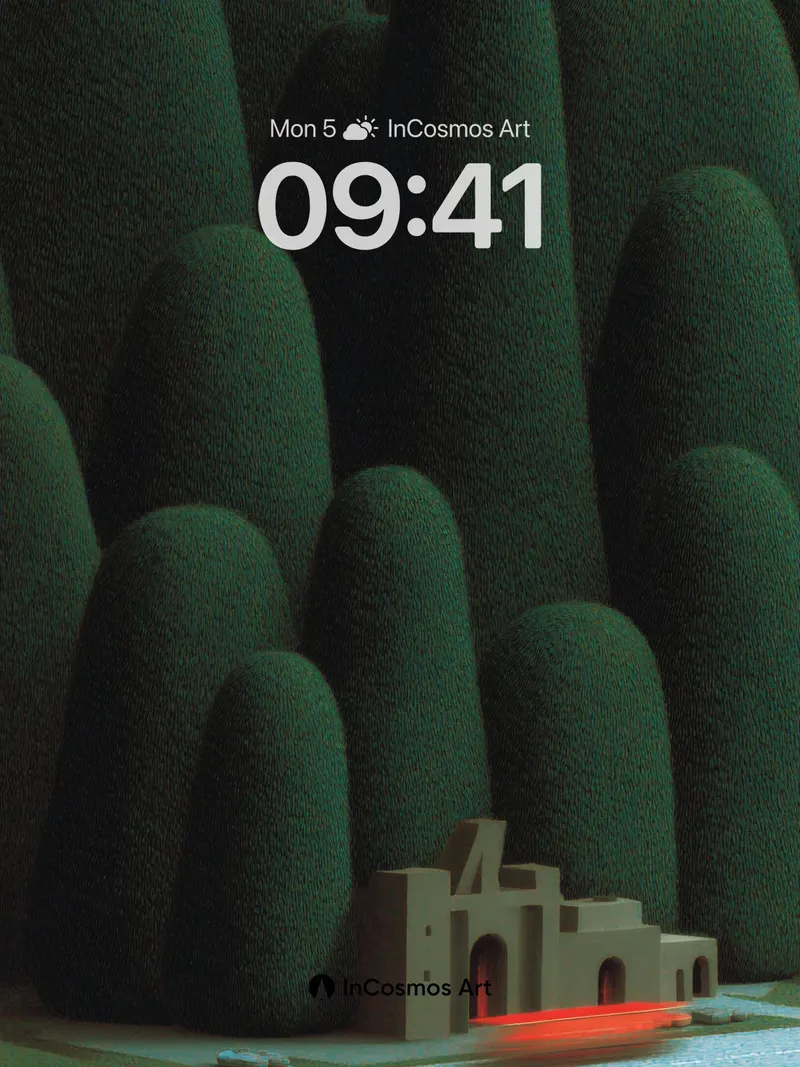
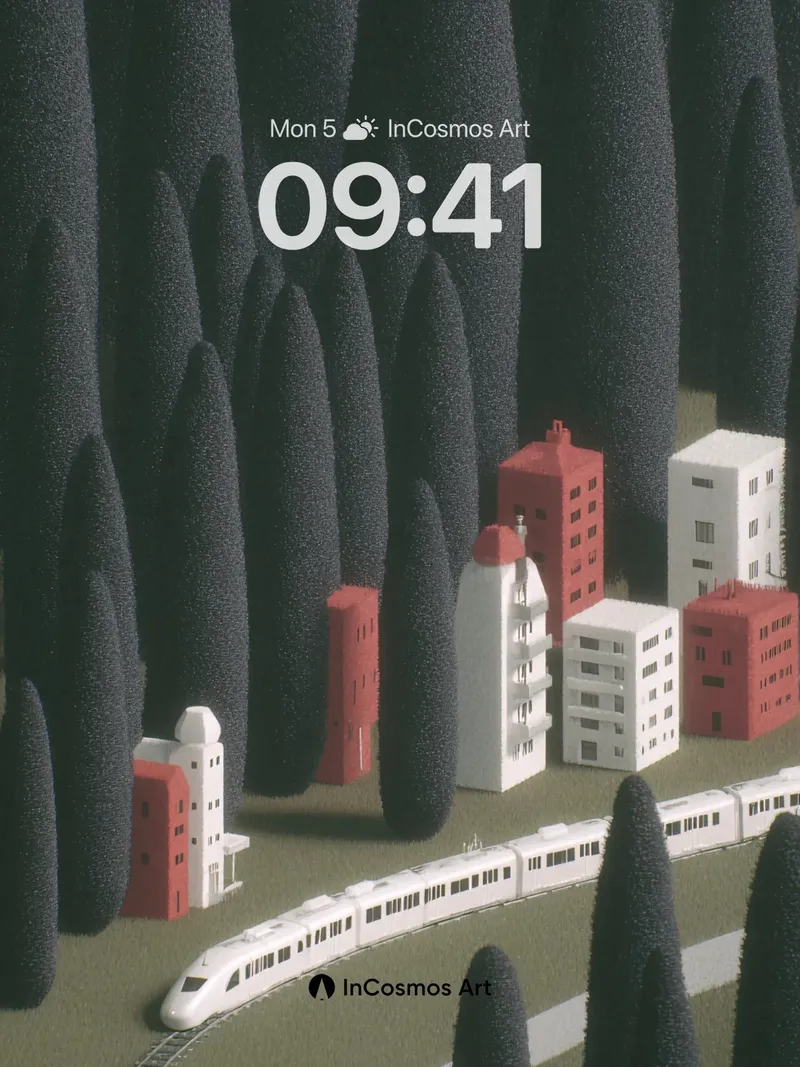
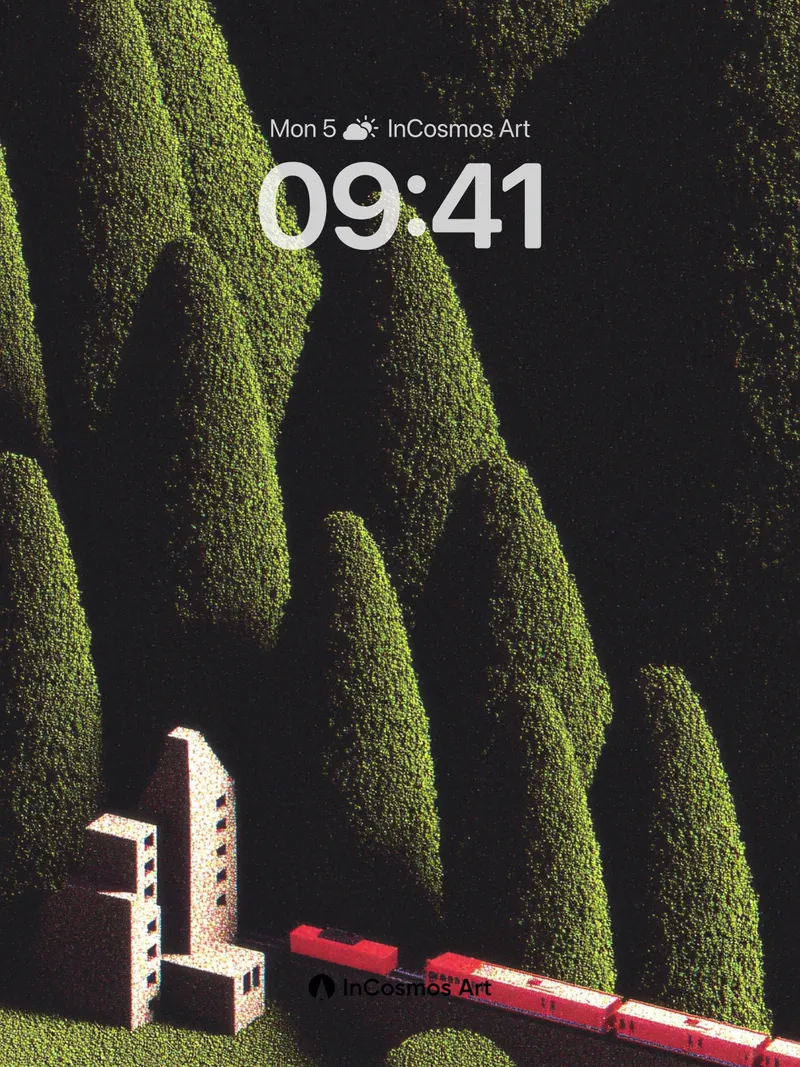
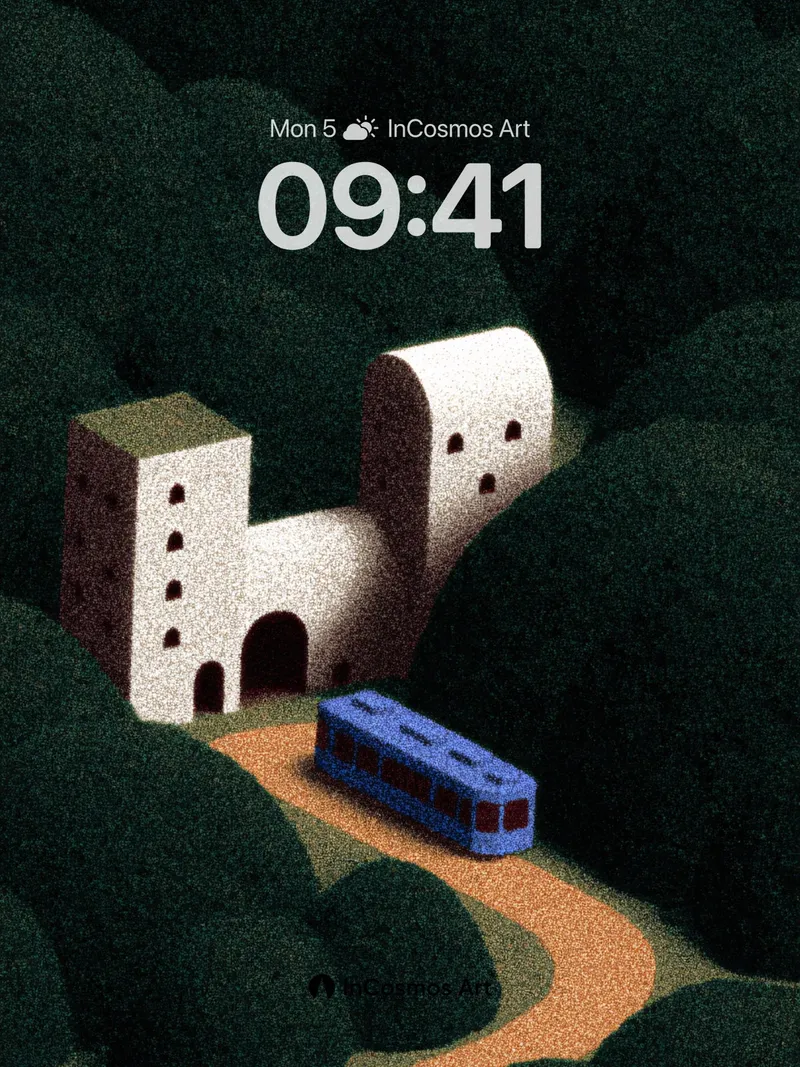
Under a deep blue night sky, a red train glides along a white arched bridge, traversing green mountain forms trimmed into conical shapes. Buildings emerge above the treetops, standing in silent isolation like islands. These structures are not naturally grown but extensions of human order, symbolizing intervention and transformation of nature. The train's path acts as a moving boundary line, linking city and wilderness, hinting at the rupture between modern mobility and rooted belonging. As tracks wind through undulating terrain, they cease to be mere transport routes and become ritualistic pathways—reminding travelers of direction within systematized spaces.
Topology of the City
Here, the city is not defined by streets but by form. Tall buildings are embedded within the forest canopy, resembling forgotten monuments. Their existence depends not on function but on placement and proportion. This arrangement disrupts traditional urban density logic, instead emphasizing visual rhythm and layering. Each structure functions as an independent symbol, collectively forming an abstract map. Human activity condenses into moving red dots, while the environment becomes a backdrop carrying meaning.
Redesigning Nature
Trees are no longer wild aggregations but geometrically uniform volumes. Their consistent height and outline create a landscaped forest that appears algorithmically ordered. This intervention is not destruction but dialogue—integrating nature into human perception while preserving its enigma. When trains pass through these 'engineered landscapes,' passengers witness more than scenery; they observe the tension between civilization and ecology.
Red as Medium
Red permeates every scene, appearing as both train color and occasional mountain feature. It is not merely decorative but emotional signaling. In darkness, red draws focus, evoking alertness and hope. It marks the industrial age and represents life’s warmth. Within this cool geometric world, red injects warmth, turning mechanized journeys into poetic experiences.
Fluid Belonging
Tracks without fixed endpoints suggest perpetual transition. Residents commute between cities, identities shifting with surroundings. This fluidity reflects contemporary experience: belonging no longer stems from land but from movement. Each turn of the train affirms the unknown, while passengers redefine themselves in motion.
Silent Narrative
No figures appear, yet stories abound. Through composition, color, and trajectory, a wordless parable unfolds about expansion, control, and coexistence. This is a visual meditation inviting reflection on human-nature and individual-system relationships. Amidst technology and aesthetics, how do we locate ourselves? The answer may lie on that distant red track.